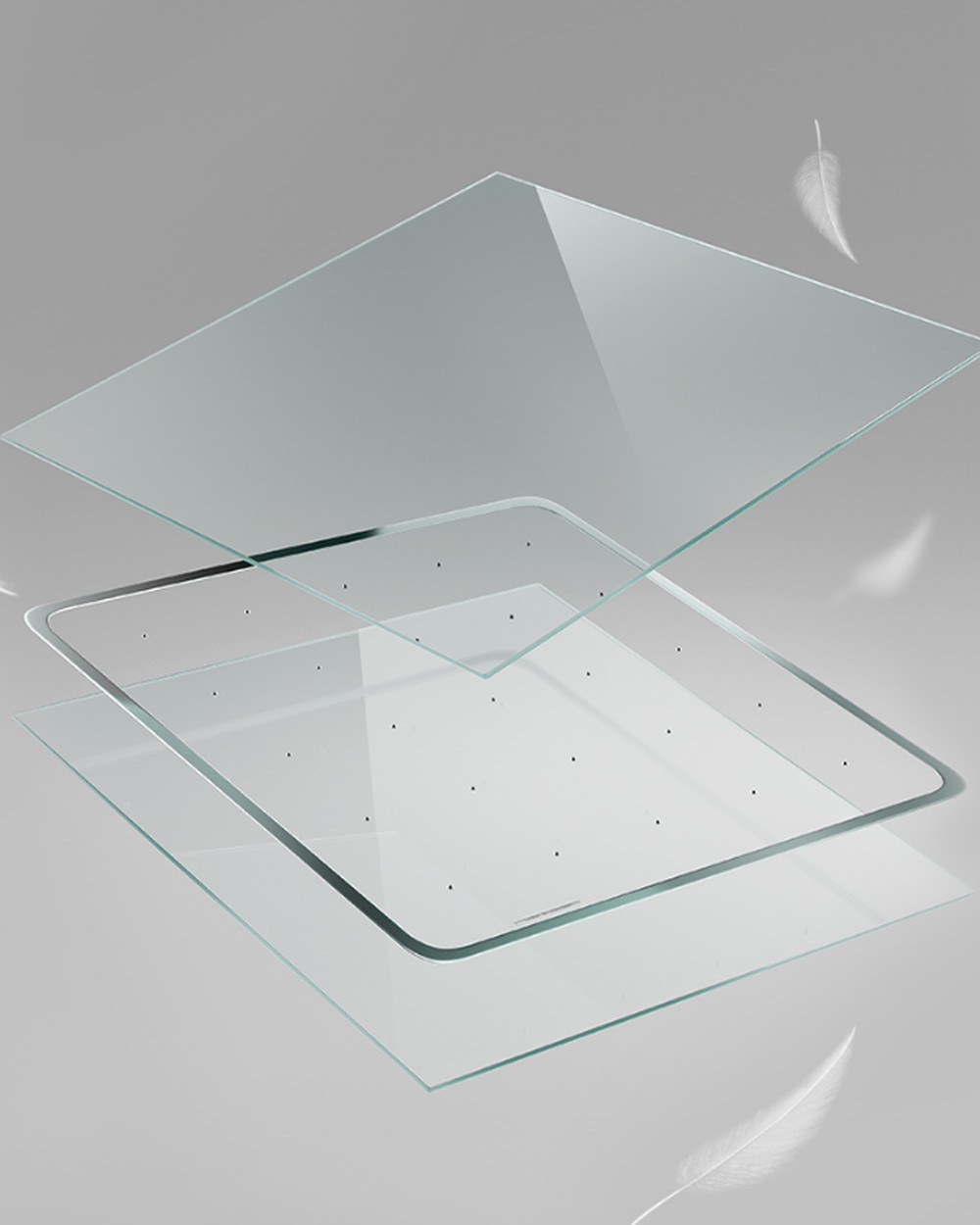
A window is only as good as its insulating glass unit (IGU). Our standard package is a hybrid IGU: an outer argon-filled insulating glass unit stacked with an inner vacuum insulating glass unit (VIG), tuned for the climate. The result is a whole-window U-value approaching zero.
Six packages. Three climates, two levels of insulation.
Choose your climate, then your level. ZERO 06 Daylight brings in the most light and free winter sun. ZERO 04 Ultimate is our lowest U-factor, R-21 to R-23 at the center of the glass.
KØLD
Cold climates
Boston, Toronto, Montreal, Calgary, Chicago, Cleveland, Minneapolis, Pennsylvania, Denver, Aspen, Telluride, Salt Lake City
ZERO 06 · Daylight
0.054U-factor, Btu/h·ft²·°F 0.31 W/m²K
R-18.5R-value, h·ft²·°F/Btu RSI 3.26
SHGC
0.49
Visible light
76%
High-solar-gain Low-E on surfaces 2, 4 and 5
Low-iron glass, all three lites
Best for Sunny south, east and west elevations, where winter sun is free heat.
ZERO 04 · Ultimate
0.047U-factor, Btu/h·ft²·°F 0.27 W/m²K
R-21.1R-value, h·ft²·°F/Btu RSI 3.71
SHGC
0.35
Visible light
64%
High-solar-gain Low-E on surfaces 2 and 4
Triple-silver Low-E on surface 5
Low-iron outer and middle lites, clear inner lite
Best for North elevations, large glazed areas and the coldest, highest sites.
MILD
Mixed climates
New York, New Jersey, Washington DC, Virginia, Charlotte NC, Nashville and Tennessee, Atlanta, Seattle, Vancouver, San Francisco
ZERO 06 · Daylight
0.054U-factor, Btu/h·ft²·°F 0.31 W/m²K
R-18.6R-value, h·ft²·°F/Btu RSI 3.28
SHGC
0.35
Visible light
67%
Double-silver Low-E on surface 2
Low-E on surfaces 4 and 5
Low-iron glass, all three lites
Best for Bright, color-neutral interiors with balanced year-round comfort.
ZERO 04 · Ultimate
0.044U-factor, Btu/h·ft²·°F 0.25 W/m²K
R-22.6R-value, h·ft²·°F/Btu RSI 3.99
SHGC
0.27
Visible light
53%
High-solar-gain Low-E on surface 2
Triple-silver Low-E on surfaces 4 and 5
Low-iron outer lite, clear vacuum unit
Best for The lowest heat loss in a mixed climate, with extra summer shading.
HEIT
Hot climates
Miami and Florida, Houston, Austin, New Orleans, South Georgia, Phoenix and Arizona, Las Vegas, Los Angeles and Southern California
ZERO 06 · Daylight
0.054U-factor, Btu/h·ft²·°F 0.31 W/m²K
R-18.6R-value, h·ft²·°F/Btu RSI 3.28
SHGC
0.26
Visible light
61%
Triple-silver solar-control Low-E on surface 2
Low-E on surfaces 4 and 5
Clear glass, all three lites
Best for Clear, bright views with strong solar control.
ZERO 04 · Ultimate
0.044U-factor, Btu/h·ft²·°F 0.25 W/m²K
R-23.0R-value, h·ft²·°F/Btu RSI 4.05
SHGC
0.20
Visible light
45%
Triple-silver solar-control Low-E on surface 2
Triple-silver Low-E on surfaces 4 and 5
Clear glass, all three lites
Best for Maximum heat rejection where cooling loads and glare matter most.
Calculated Center-of-glass values, LBNL WINDOW 8.1 to NFRC 100-2010. Every package is the same hybrid build-up: outer lite, 12 to 18 mm argon cavity, and a vacuum insulating unit, fitting the standard F-Series glazing pocket.
Mixing levels pays off. In heating climates, free solar gain on sunny elevations can outweigh a lower U-factor, so a project can combine ZERO 06 on the south, east and west with ZERO 04 on the north. We model both for your project.
The complete window, frame included
Whole-unit values at NFRC standard sizes with ZERO 04 glass. Every system, both levels and all three climates are listed on the Performance page.
R-11.8GR85 Fixed, complete unit with ZERO 04 · U 0.085 Btu/h·ft²·°F (0.48 W/m²K)
R-10.8GR85 Dual Action, complete unit with ZERO 04 · U 0.093 Btu/h·ft²·°F (0.53 W/m²K)
R-9.4GR85 Swing Door, complete unit with ZERO 04 · U 0.106 Btu/h·ft²·°F (0.60 W/m²K)
R-8.3GR70 Dual Action, complete unit with ZERO 04 · U 0.120 Btu/h·ft²·°F (0.68 W/m²K)
ZERO 08Certified basis
The tested hybrid configuration, at a center-of-glass U-factor in the 0.08 Btu/h·ft²·°F class. Our certified claims rest on ZERO 08 today; ZERO 06 and ZERO 04 carry the Calculated label until their own NFRC and CSA testing is complete.
Three ways heat is lost
Cold does not move. Heat does.
A window loses heat by three mechanisms at once. The insulating unit is engineered to shut down all three, in the order they matter.
Conduction
Heat passes directly through the glass and the gap by molecular collision. A vacuum has almost no molecules, so it barely conducts — which is why the vacuum layer does most of the work.
Convection
Warm interior air circulates against the cold inner pane and dumps heat into it. A vacuum gap has no gas to convect, and the outer argon gap is sized to suppress circulation.
Radiation
Every warm surface radiates infrared across the gap. A vacuum can't stop radiation, so a Low-E coating closes that last pathway by reflecting infrared back to its source.
Vacuum insulating glass
A vacuum layer 0.3 mm thick, doing what a 100 mm cavity cannot.
≈ 0.08
Center-of-glass U-factor
The vacuum unit alone reaches a U-factor near 0.08 Btu/h·ft²·°F (about 0.4 W/m²K) — two to four times better than a conventional argon insulated unit, and six to ten times better than single-pane glass.
Passive
Meets Passive House alone
At that performance level, a single vacuum unit already meets international passive-house requirements for windows and doors — before it is even paired with the outer argon unit.
0.3 mm
Wall performance, glass thickness
Because the vacuum layer is only about 0.3 mm, the whole hybrid unit fits an ordinary glazing pocket. You get wall-level insulation without wall-level thickness.
We never sell a bare vacuum unit. It is always the inner half of a hybrid: an outer argon-filled insulated unit takes the wind load, thermal shock, and surface wear, while the vacuum unit — the more thermally stable, more valuable component — sits in the protected inner position.
Why the vacuum unit sits inside
Three reasons the vacuum unit takes the protected inner position.
Less stress on the edge seal
The outer argon unit absorbs most of the temperature difference between outside and inside. The vacuum unit then sits in a stable, moderated environment, so its edge seal sees far less differential expansion across thousands of thermal cycles.
Proprietary metallic edge seal
The vacuum unit's edge is a hermetic metal-to-glass seal of a flexible, proprietary non-leaded metallic alloy rather than glass frit. The alloy conducts little heat, tolerates slight movement without cracking, and is sealed below the glass annealing point so the pane keeps its full tempered strength.
A getter keeps the vacuum
A reactive getter inside the sealed cavity chemically locks any stray gas molecules that outgas over time, so the vacuum holds for the life of the unit. No power and no maintenance — it works passively.
0.044Center-of-glass U-value in Btu/h·ft²·°F (0.25 W/m²·K) with ZERO 04 hybrid glass, R‑23. The vacuum unit alone reaches about 0.08 Btu (about 0.4 W/m²·K).
6–10×Better than single-pane glass, and 2–4× better than a conventional insulated unit
39 dBWeighted sound reduction index, quieting traffic and construction noise
50 yrProjected service life of the vacuum glass unit itself, based on the glass maker’s 11 years of accelerated-ageing testing. We warrant the vacuum unit for 25 years.
How the packages work
Every ZERO package coats both faces of the vacuum, which sets the insulation. The coating on surface 2 is then chosen for the climate.
4 + 5
Insulation
A vacuum cannot conduct or convect, so radiation is the only way heat crosses it. Low-E on both vacuum faces closes that path. Triple-silver coatings close it further: that is the step from ZERO 06 to ZERO 04.
2
Solar control, by climate
The outer coating tunes the solar heat gain coefficient (SHGC): high where winter sun is welcome, low where cooling dominates. It barely changes the U-factor, so it is chosen for comfort and energy, not insulation.
The full glazing stack
The hybrid unit in cross-section, exterior to interior. Surfaces are numbered 1 to 6 by the industry-standard convention.
Reading left to right: an outer glass lite, a 12 to 18 mm argon cavity with a warm-edge spacer, then the vacuum unit — two lites separated by a 0.3 mm vacuum. Low-E coatings sit on the cavity face of the outer lite (surface 2) and on both faces of the vacuum (surfaces 4 and 5). A Super Spacer® Premium silicone-foam warm-edge spacer by Quanex seals the argon cavity, keeps the glass edge warm, and removes the thermal bridge a metal spacer would create. Drawing not to scale.
Proprietary metallic pillars
Atmospheric pressure presses on the vacuum unit with roughly 10 tons per square meter (about a ton per square foot), so tiny pillars hold the two lites apart. Ours are discs of a proprietary, non-leaded metallic material, no more than 0.75 mm across and about 0.3 mm tall, the height of the vacuum gap, set on a grid about 55 mm (2⅓″) apart. The material is strong enough not to crush or crack under that load for decades, yet conducts heat poorly, so each pillar is a very small thermal bridge. They are nearly invisible from normal viewing distance.
Proprietary non-leaded metallic edge seal
The perimeter is a hermetic metal-to-glass seal: a proprietary, non-leaded metallic solder bonded to metallized glass edges, rather than the glass-frit seal used in many vacuum units. It is made below 280 °C, so the glass keeps its full tempered strength, and the alloy is flexible enough to absorb the movement that cracks rigid seals.
The getter
A small getter sealed inside the vacuum, helped by the edge seal material itself, chemically captures stray gas molecules that slowly release from the glass surfaces over time. That keeps the vacuum, and the insulation, at full strength for the life of the unit, with no power and no maintenance.
Not all vacuum glass is the same
Our vacuum unit is a later-generation design. Here is how it differs from vacuum glass made the conventional way.
GlasFëns vacuum unit
Conventional vacuum glass
Support pillars
Proprietary metallic pillars on a wide 55 mm (2⅓″) grid
Steel or ceramic, often every 20 to 28 mm on thinner glass
Edge seal
Flexible, proprietary non-leaded metallic seal that tolerates large temperature differences
Rigid fused glass-frit (solder glass) seal that can crack under extreme temperature differences
How the vacuum is made
Pumpless: sealed in a single step under vacuum, with no pump-out hole
Pumped out through a hole in the glass, which is then sealed with a visible cap or plug
Getter
Concealed at the edge, out of sight once glazed
In some units, visible in the glass area
Edge in the frame
Narrow seal, hidden under the glazing bead
Wider seals and caps can show at the edge of the glass
Low-E inside the vacuum
On both vacuum faces: the seal is made below 280 °C, cool enough to protect the coatings
Frit seals need more than 400 °C, which limits the coatings that can go inside
Glass
Two fully tempered lites; the low seal temperature keeps full temper
Often two 3 mm lites; high-temperature sealing can relax the temper
Pillar spacing for conventional units per published maker data (20 to 28 mm grids). Our vacuum unit data per the glass maker.
More than insulation
The same vacuum layer that stops heat also brings quiet, altitude-proof stability, and a long service life.
Quiet as well as warm
A weighted sound reduction index above 39 dB brings a busy street close to library quiet. The vacuum layer works against both the low-frequency rumble of traffic and the high-frequency edge of construction, noticeably better than a conventional insulated unit.
Works at any angle, any altitude
There is no gas in the vacuum layer to expand or contract, so performance does not change with elevation, geography, or mounting angle. The U-value holds whether the glass is vertical, sloped, or overhead, which suits skylights, sunrooms, and daylighting roofs where sealed gas units struggle.
Built to last
The unit is inorganic, with nothing to off-gas or degrade. A flexible, proprietary metallic edge seal absorbs the movement that cracks rigid seals across large indoor-to-outdoor temperature swings, and a built-in getter holds the vacuum for decades. Every unit starts from tempered safety glass and passes multi-stage inspection, so the spontaneous-breakage rate stays comparable to an ordinary insulated unit.